HVAC Replacement Cost in New Braunfels, TX (2026)
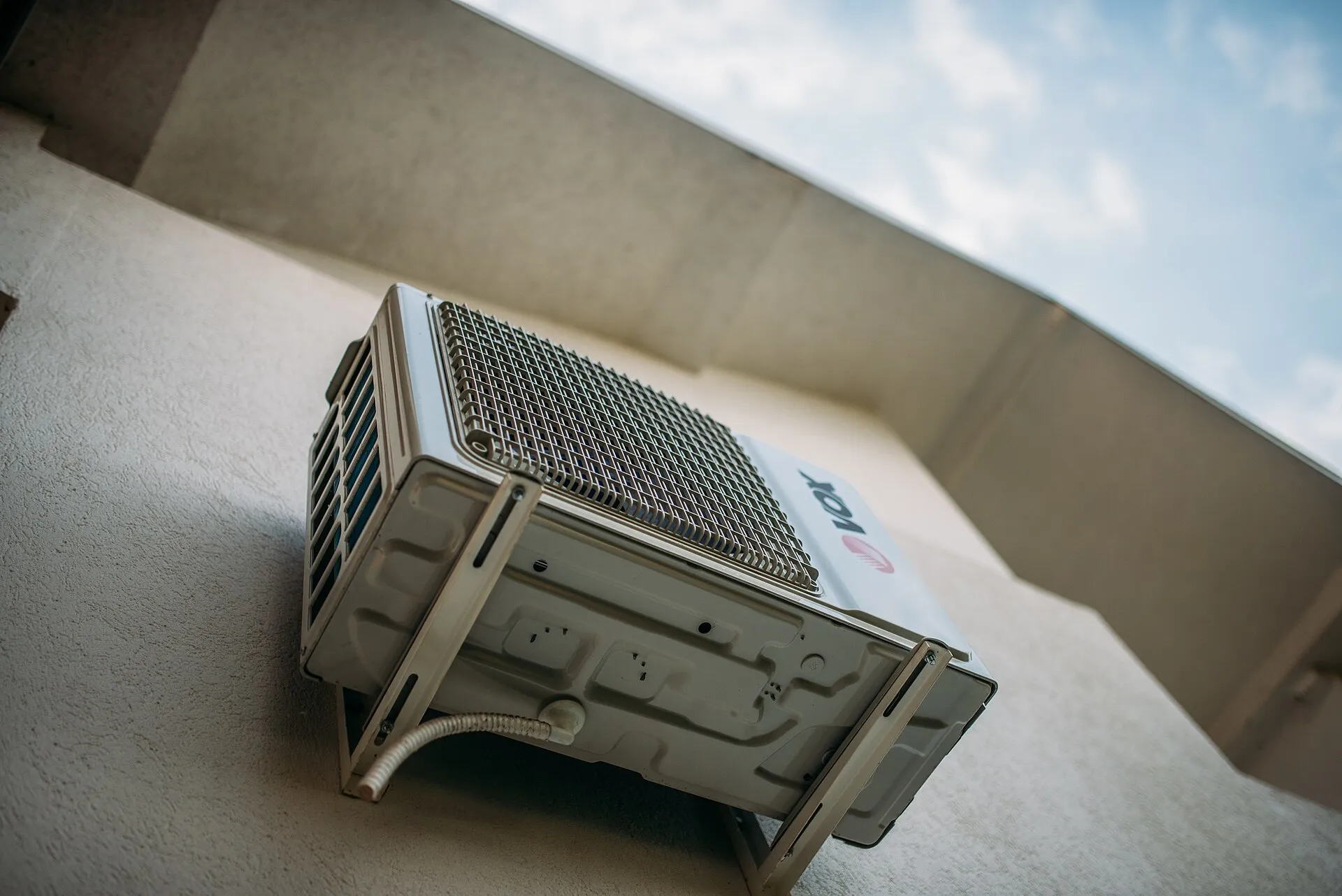
Photo: Shixart1985 / Wikimedia Commons — CC BY 2.0 ( source )
How much does HVAC replacement cost in New Braunfels?
A typical HVAC replacement in New Braunfels runs $5,000 – $8,000, with a full range of $3,800 – $11,000. Where you land depends on system size, efficiency tier, and ductwork condition. The table below sets the local figures against national benchmarks so you can sanity-check any quote. homeyou.com (New Braunfels market data)
| Scope | Range |
|---|---|
| New Braunfels typical install | $5,000 – $8,000 |
| New Braunfels full range | $3,800 – $11,000 |
| Full system (AC + furnace), national | $7,500–$12,500 |
| Central AC unit alone, national | $4,500–$8,500 |
| Equipment only, 1.5–3.5 ton | $2,000–$3,500 |
If ductwork replacement is needed, add roughly $15 to $18 per square foot of conditioned space, per our 2026 local market research. Get three written estimates before deciding.
What drives HVAC replacement cost up or down?
Four factors move the price: system size, efficiency tier, ductwork condition, and brand plus labor access. A unit at the 14.3 SEER2 legal minimum costs less upfront, but a 23.5 SEER2 system saves about $6,724 over an 18-year lifespan per DOE data. The breakdown below shows how each factor plays out locally. energy.gov (DOE)
System size ( tonnage How much cooling a system delivers (1 ton ≈ 12,000 BTU/hour). Bigger home, more tons — but bigger is not always better. Full definition )
Larger homes need more capacity. An undersized system runs continuously and fails early, while an oversized one short-cycles and wastes energy.
Efficiency tier
Texas’s legal minimum is 14.3 SEER2 A cooling-efficiency rating — higher means lower running cost. Texas’s legal minimum is 14.3; ENERGY STAR starts at 15.2. Full definition ; ENERGY STAR starts at 15.2, the federal tax credit at 17.0, and the New Braunfels Utilities rebate at 18. A minimum-efficiency system costs less upfront, but a 23.5 SEER2 system saves about $6,724 in energy costs over an 18-year lifespan, per DOE data, so the premium often pays back in a hot-humid climate. Estimate the difference for your home:
| Efficiency tier | SEER2 | Lifetime savings vs. minimum |
|---|---|---|
| Minimum | 13.4 | $0 |
| ENERGY STAR | 15.2 | $1,853 |
| Best available | 23.5 | $6,724 |
Estimate what a higher-efficiency system saves you
Higher SEER2 ratings cut cooling cost. These are sourced estimates for the New Braunfels climate — a contractor confirms the real numbers after a load calculation.
Based on EIA's average Texas-region cooling use (~3,875 kWh/yr for a typical home, scaled to your size) at New Braunfels Utilities' published rate (~10.3¢/kWh), capped at U.S. DOE lifetime figures. A budgeting estimate, not a quote.
At 18 SEER2+, New Braunfels Utilities pays a rebate of up to $1,150 on top of these savings. See the NBU rebate.
How this is estimated, and the SEER2 tiers that matter
Savings scale with the efficiency gap between your current rating and the target: a system that is twice as efficient uses roughly half the cooling energy for the same comfort. We anchor the range to U.S. Department of Energy figures for the hot-humid South — a best-available 23.5 SEER2 unit saves up to $6,724 over an 18-year life versus a baseline system. Your home size sets the starting cooling spend. This is a budgeting estimate, not a quote.
- 14.3 SEER2 Texas legal minimum The lowest you can legally install in the South region.
- 15.2 SEER2 ENERGY STAR The efficiency line worth targeting for most homes.
- 17.0 SEER2 Federal tax credit Unlocks the 25C residential energy-efficiency credit.
- 18 SEER2 NBU rebate New Braunfels Utilities pays up to $1,150 at this tier.
Sources: DOE FEMP (savings + SEER2 minimums), ENERGY STAR (15.2 certification, 17.0 tax credit), NBU (18 SEER2 rebate). Texas's legal minimum is 14.3 SEER2 — not 15.2, a figure often mislabeled as the minimum.
Ductwork condition
Older homes near the historic district and Gruene often have non-standard duct runs that add labor. Newer subdivisions such as Veramendi and River Chase, and nearby communities like Vintage Oaks toward Canyon Lake, typically have compatible ductwork.
Brand and labor access
Premium brands such as Carrier, Lennox, and Trane cost more upfront and typically carry longer warranties. Attic-mounted air handlers, common in New Braunfels homes, add labor time versus closet installs.
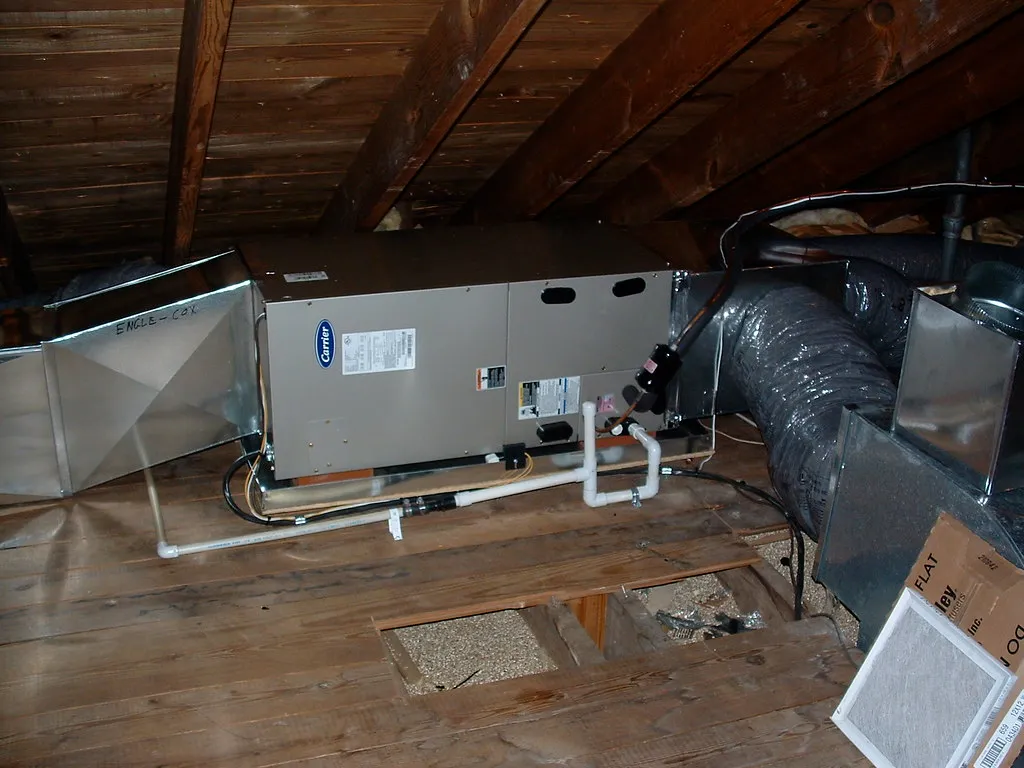
An attic-mounted air handler with its duct runs. Tight attic access like this is one of the biggest swing factors on a New Braunfels install quote. It adds labor time a closet install doesn’t.
What rebates and tax credits lower the cost in New Braunfels?
Two incentives stack on a qualifying high-efficiency install: a New Braunfels Utilities rebate of up to $1,150 for a SEER 18 or higher AC or heat pump, and the federal 25C tax credit worth 30 percent of project cost, capped at $600 for central AC or $2,000 for a heat pump. Together they can offset a meaningful share of the premium for a more efficient system. New Braunfels Utilities (rebates)
New Braunfels Utilities rebate
NBU pays a bill credit of up to $1,150 per account, per 12 months, for replacing an aging unit with a SEER 18 or higher system: $500 for a straight-cool or gas AC, $550 for a heat pump, and $200 for a mini-split, plus up to $80 for a tune-up. The high-efficiency floor is SEER 18, so this only applies above the 17.0 tax-credit tier. See NBU residential rebates.
Federal 25C tax credit
The federal Energy Efficient Home Improvement Credit returns 30 percent of the project cost, up to $600 for a central AC rated SEER2 17.0 or higher (EER2 12.0 or higher), or up to $2,000 for a qualifying heat pump. You claim it on IRS Form 5695, and it offsets the tax you owe rather than paying cash up front. Confirm the current thresholds on
ENERGY STAR (federal tax credits)and IRS (Form 5695).
What should a complete HVAC quote include?
A complete quote lists the equipment make, model, and SEER2 rating, labor, the local mechanical permit fee as a line item, old-system disposal, and equipment and labor warranties stated separately. An itemized written estimate is what lets you compare bids fairly, so treat a vague lump sum as a warning sign. The FTC advises getting estimates in writing before you hire. FTC (hiring a contractor)
- Equipment make, model, and SEER2 rating
- Labor hours and any subcontractors
- Local mechanical permit fee as a line item
- Old system disposal fee
- Manufacturer (equipment) and contractor (labor) warranties, stated separately
- Lump-sum quote with no line items
- No permit fee listed, which means no permit is being pulled
- Pressure to sign the same day
- A price drastically lower than other quotes
When should you replace an HVAC system instead of repairing it?
Use the 50% rule: if a repair costs more than half the replacement value, or the system is 12 to 15 years or older, replacement is usually the better financial decision. A system still running R-410A refrigerant reaches that tipping point sooner, because the EPA banned manufacturing of new R-410A systems on January 1, 2025. Carrier (repair vs. replace)
The refrigerant your current system uses changes the calculation. Units built before 2025 typically run R-410A The refrigerant in most pre-2025 systems. Manufacturing of new R-410A systems was banned in 2025, so parts will get scarcer. Full definition , which is now being phased out, so a costly repair on one buys less future runway than it used to. Our repair-or-replace guide walks through the three rules of thumb (the dollar rule, the 50% rule, and the 3-minute rule) in full, and the how-to-choose guide covers verifying the contractor before you commit.
Expected lifespan
Expected lifespan in the hot-humid South is 15 to 20 years with proper maintenance, and DOE data shows an 18-year average. In the 12 to 15 year window, rather than waiting for a failure, it pays to get matched with a New Braunfels HVAC contractor for replacement quotes. A summer breakdown means premium emergency rates, multi-day waits during peak season, and potential hotel costs. See the DOE lifespan and efficiency data.