What AC Repair Actually Costs in New Braunfels (2026 Prices)
How much does AC repair cost in New Braunfels?
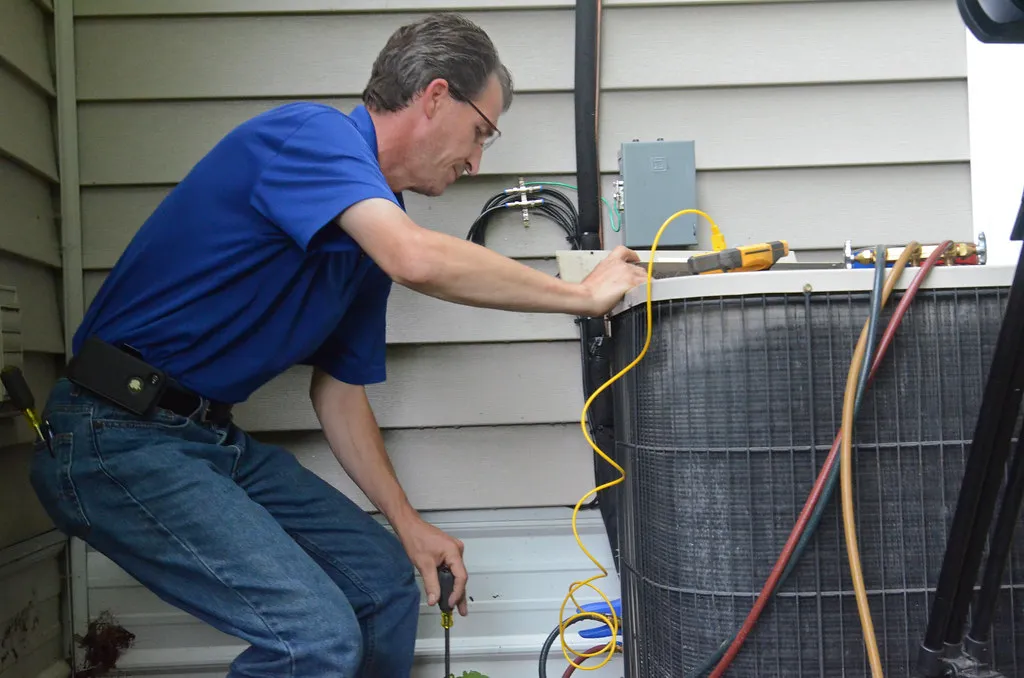
Most repairs land in the $150 – $650 range. What varies far more than the repair itself is the diagnostic fee, which runs $79 to $169 across the New Braunfels contractors publishing prices, and whether that fee comes off the bill. Small electrical parts like a capacitor or contactor sit at the bottom of the range. A compressor or evaporator coil runs into four figures and turns the conversation into a replacement decision.
Nationally the same visit runs $75 to $200 per HomeGuide’s 2026 repair-cost data, so New Braunfels sits inside the national band. What is unusual here is not the level but the spread, and that spread is the subject of this page.
What do New Braunfels HVAC contractors actually charge?
Three New Braunfels contractors publish pricing, and they do not agree. The diagnostic fee runs $79 to $169 for the identical visit, and two of them quote repairs in fundamentally different units: one all-in with parts, one labor-only. A homeowner comparing those two quotes is comparing different things and does not know it.
No contractor can publish this comparison, because it undercuts their own quote. A guide site can.
| Moorhead | BAM HVAC | Factory A/C Direct | |
|---|---|---|---|
| Diagnostic / service call | $79 flat | $169 (weekdays 9 to 5, or by appointment) | Not published; membership advertises a $149 dispatch saving |
| What happens to the fee | Credited toward the repair if booked | Waived if repair or replacement is performed | No dispatch fee with qualifying repairs, via membership |
| Quoting model | All-in, parts and labor together | Labor only, parts billed separately | Flat-rate, not published |
| Membership | Not published | Not published | Comfort Club, $39/month |
| TDLR license published on site | No | No | Yes, TACLB29166E |
Sources: Moorhead Service Company (price list published June 21, 2026), BAM HVAC, and Factory A/C Direct, all re-verified 2026-08-05.
A 114% spread on the same service call, and neither number is wrong. But three opinions on a big repair is the difference between roughly $237 and $507 spent before a single part is replaced.
Waived and credited are not the same word. BAM waives the fee if you have the work done; Moorhead credits it toward the repair. They land in a similar place unless the repair costs less than the fee, or a credit applies to labor but not parts. Ask which.
Why do two quotes for the same part look nothing alike?
Because BAM publishes labor-only fees and Moorhead publishes all-in prices. Compare the two directly and you get nonsense: a capacitor at $80 labor-only and a capacitor at $150 to $350 all-in are not a bargain and a rip-off, they are the same job quoted in different units. One sentence resolves it: is that price parts and labor together, or labor only?
| Repair | BAM (labor only) | Moorhead (parts + labor) | National all-in |
|---|---|---|---|
| Run capacitor | $80 | $150–$350 | $100–$250 |
| Dual run capacitor | $90 | Not broken out | — |
| Start capacitor | $100 | Not broken out | — |
| Contactor, single pole | $80 | $175–$375 | $200–$450 |
| Contactor, 2 pole | $100 | — | — |
| Contactor, 3 pole | $120 | — | — |
| Condenser fan motor | $300–$350 | Not published | $200–$700 |
| Blower motor | $350–$400 | $400–$850 | $300–$900 |
| Fan blade, added to a motor job | $75 | — | — |
Local figures: BAM HVAC and Moorhead, re-verified 2026-08-05. National all-in ranges: HomeGuide, 2026.
The capacitor A small electrical part that gives the compressor and fan motors their starting jolt. One of the most common failures on a residential system, and one of the cheapest to fix. Full definition is worth knowing by name. It is one of the most common failures on a residential system, and one of the cheapest to fix: if your outdoor unit hums but the fan will not start, a capacitor is the first thing a technician will check and often the whole repair. Carrier’s capacitor guidance describes the symptoms and puts the typical all-in replacement at $100 to $400 nationally.
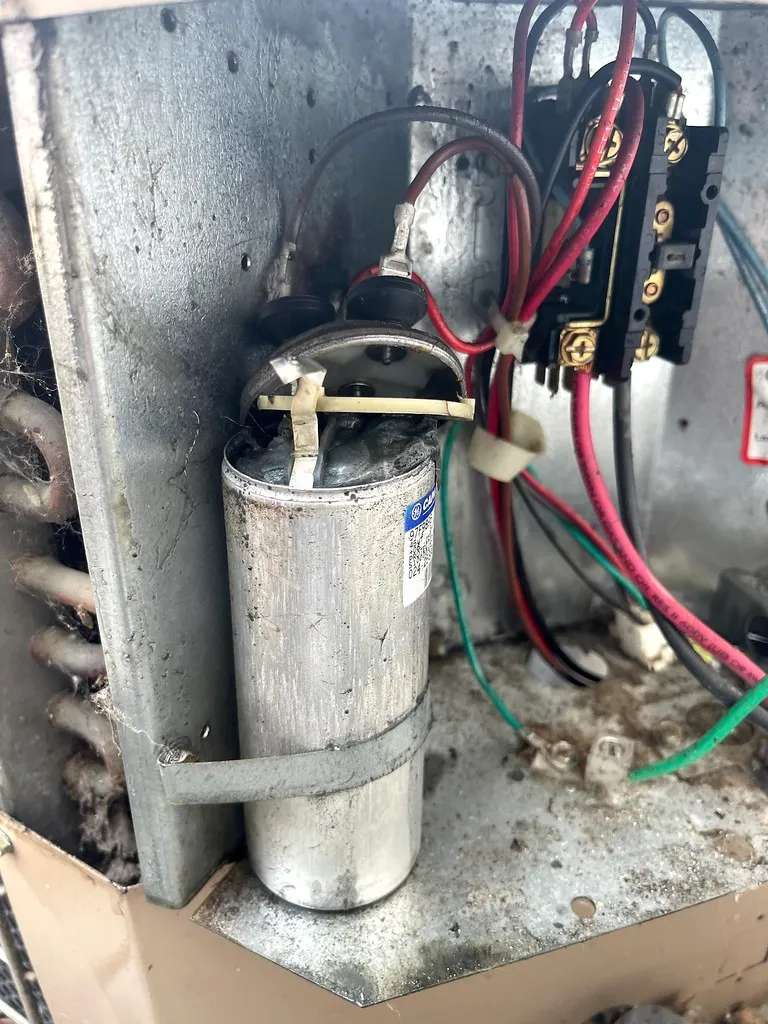
Photo: Vernon Air Conditioning / Flickr — CC BY 4.0 ( source )
- Is this price parts and labor together, or labor only?
- What is the diagnostic fee, and is it credited or waived?
- Does the part carry a manufacturer warranty, and is it still active?
- For refrigerant: how many pounds, and what is the price per pound?
How much does refrigerant cost in New Braunfels?
BAM publishes $299 for a leak check with up to 2 pounds of R-410A, then $70 per additional pound. That is a real, on-the-record local price, and it lets you do arithmetic most homeowners never see: a 4-ton system that has lost most of its charge costs around $719 to refill before the leak itself is repaired. BAM HVAC published pricing
A residential system holds 6 to 15 pounds of R-410A, roughly 2 to 4 pounds per ton. So a 4-ton New Braunfels system that has lost most of its charge:
| Leak check plus the first 2 lbs of R-410A | $299 |
| Remaining 6 lbs at $70 per pound | $420 |
| Refrigerant and leak check subtotal | $719 |
| Plus the actual leak repair | $200–$1,500 |
That is $919 to $2,219 before anything is improved about the system. You have paid to refill a system that leaked once and will leak again.
What homeowners around here actually report paying
Published contractor pricing is one thing. What people say they were quoted is another. The figures here are self-reported homeowner numbers from public forum discussion, retrieved 2026-08-04, San Antonio metro rather than New Braunfels specifically; it is the same market and the same contractors, but this is not a survey.
One homeowner with a 23-year-old AC collected three replacement quotes for the same job: two in the $12,000 to $14,000 range and one at about $8,000, a $6,000 spread that is roughly the price of a whole small system. Even at the top of the local diagnostic fees, three opinions cost around $500 and can save thousands. The most useful thing in the whole discussion was one homeowner describing a furnace problem:
Everyone that came out tried to sell me a whole new system. The guy from Beltran spent a little time troubleshooting and fixed the problem for $150.
That is the entire repair-versus-replace tension in two sentences. A technician who diagnoses carefully finds a small repair; a technician incentivised to sell equipment finds a replacement. Both are looking at the same machine.
Two more things locals tell each other. First, ask for a Manual J load calculation and do not let anyone oversize the system: an oversized unit short-cycles, dehumidifies poorly, and wears out faster, covered in the system size guide. Second, many Texas systems are heat pumps whether or not anyone calls them that, and the federal 25C credit pays up to $2,000 for qualifying heat pump installs at 30% of cost. Verify eligibility on the IRS 25C page before relying on it.
What does a typical AC repair cost?
Nationally, all-in: from $75 to $250 for a condensate drain clear at the bottom, up to $600 to $2,500 for a compressor and $1,000 to $4,500 for an evaporator coil at the top. Treat the national ranges as the sanity check against any local quote. HomeGuide, 2026 AC repair cost data
| Repair | National 2026 all-in range |
|---|---|
| Condensate drain clear and flush | $75–$250 |
| Thermostat replacement | $140–$350 |
| Expansion valve (TXV) | $300–$500 |
| Refrigerant leak repair | $200–$1,500 |
| Compressor | $600–$2,500 |
| Evaporator coil | $1,000–$4,500 |
The compressor and the evaporator coil account for nearly every four-figure repair quote. If your quote names either, stop and read the compressor guide before authorising anything.
The repair-or-replace decision for those two parts has its own guide: compressor repair vs replace.
How much is the average AC service call?
Locally, $79 to $169 as published by New Braunfels contractors. Nationally the range is $75 to $200, so this market sits squarely inside it. The number that moves more is the hourly rate behind the fee, which roughly doubles after hours. HomeGuide, 2026 AC repair cost data
Standard labor runs $75 to $150 per hour nationally; emergency or after-hours work runs $160 to $250, roughly double. Note that BAM’s $169 fee is explicitly scoped to weekdays 9 to 5 or by appointment, and none of the three publishes an after-hours premium. Ask for it before you call at 9pm in August, because that premium is the actual cost of not waiting until morning.
On memberships: Factory A/C Direct’s Comfort Club runs $39 a month, $468 a year, with annual tune-ups plus a claimed $149 dispatch saving. One call a year does not justify it, two might. A membership is also how a contractor gets a technician in front of an ageing system annually, which is where replacement conversations start.
What is the $5,000 rule for HVAC?
Multiply the system's age in years by the quoted repair cost. Over $5,000, replace; under, repair. A 6-year-old system with a $400 blower motor is 6 times 400, so $2,400: repair. A 14-year-old system with a $900 quote is $12,600: replace. It is a quick mental check, not a law, and in Central Texas it reads low. Carrier's replacement cost guidance
It is not a state rule or an industry standard. It is a consumer-facing benchmark promoted by manufacturers, including Carrier’s own replacement guidance, which is worth knowing given who benefits when the answer comes out replace. It is still a useful sanity check, and deliberately crude. Two things make it read low here specifically.
Texas is the worst climate in America for AC lifespan, and the DOE says so
The Department of Energy publishes expected residential central AC lifespan by climate zone, and the hot-humid Southeast zone, which explicitly includes Texas, comes out lowest in the country: 18 years, against 24 in northern states and 25 in the hot-dry Southwest. So when you run the rule, weigh the age input against an 18-year expectation rather than the 20-plus a national article assumes. A 14-year-old system in New Braunfels is roughly 78% of the way through its expected life. The full reasoning, including which New Braunfels homes hit the 18-year mark next, is in the system lifespan guide.
Refrigerant has moved the repair-cost input
Run the $719 refrigerant subtotal above through the rule on a 12-year-old system: 12 times 719 is $8,628, and that is before the leak repair itself. The rule says replace, and it is right.
The $5,000 rule and the 50% rule are different tests
The compressor guide uses the 50% rule: if the repair exceeds half the price of a new system, replace. Locally that threshold is roughly $2,500 – $4,000. Use the $5,000 rule as the quick mental check when you first hear a number on the phone. Use the 50% rule once you have a written quote and a real replacement figure. They usually agree; when they disagree, trust the 50% rule, because it is anchored to an actual local price rather than a national rule of thumb. Run both in the repair-or-replace calculator.
Is it worth fixing a 20 year old AC unit?
Almost never here, and the answer is firmer in Central Texas than it would be elsewhere. A 20-year-old system in this climate has run somewhere near 50,000 to 60,000 compressor hours, is past the DOE's 18-year expectation, uses R-22 or early R-410A, and any single repair buys an unknown amount of time on every other component. U.S. Department of Energy (expected lifespan by climate zone)
The exception is a genuinely trivial fix. An $80 capacitor labor charge on a 20-year-old system that is otherwise running is worth doing, because it buys a season while you plan. A $1,200 coil on the same system is not. There is also a rebate argument that runs against most people’s instinct, covered next.
Which utility serves you, and why it changes the number
Most local HVAC content assumes New Braunfels Utilities. That is wrong for a plurality of the county: CPS Energy is the largest electric utility in Comal County at roughly 63,097 customers, ahead of NBU at roughly 47,854, per FindEnergy’s Comal County data, and the two rebate programs differ in ways that change your repair math. NBU pays $80 for an AC checkup, $85 for a smart thermostat, and up to $1,150 toward a high-efficiency replacement. CPS Energy pays per cooling ton, tiered by SEER2, and pays more for replacing early, $115 to $310 per ton, than on burnout, $90 to $275, so on a 4-ton system at the middle tier waiting for the system to die costs about $100 in lost rebate. Both re-verified 2026-08-05; the timing argument is worked through in the system lifespan guide.
If you are on NBU, the $80 AC checkup rebate makes a spring tune-up close to free, which is the cheapest way to get a professional read on how much life the system has left. Compare that with Factory A/C Direct’s $468-a-year membership before signing up for either.
Verify the license, and know what the letters mean
Every HVAC contractor in Texas must hold a current TDLR license. Class A (TACLA) covers any capacity; Class B (TACLB) covers cooling of 25 tons or less, which is every residential job in this market. Residential work requires the Environmental Air Conditioning endorsement. TDLR air conditioning program
How to verify any Texas licenseOf the three contractors compared above, only Factory A/C Direct publishes its license number, TACLB29166E. That is good practice rather than a requirement, but it makes your verification a five-second job. And a TACLB is not a lesser contractor for your house: the 25-ton cap is far above any residential system.
And check more than whether the license exists: the TDLR database also shows past enforcement actions, complaints, and fines, which almost nobody thinks to look at. It takes the same thirty seconds. More on vetting in how to choose a contractor.
When the answer is replace, not repair
If the quote names a compressor or evaporator coil, if the system is past 12 years, if refrigerant is involved, or if the $5,000 rule and the 50% rule point the same way, the useful question stops being what this repair costs. See the HVAC replacement cost guide, check how much time the DOE data says you have in the system lifespan guide, and run your own numbers through the repair-or-replace calculator.