How Long Does an AC Unit Last in New Braunfels?
How long does an AC unit last in New Braunfels?
About 18 years. That is not a rule of thumb, it is the U.S. Department of Energy's expected lifespan for residential central air conditioning in the hot-humid Southeast zone that includes Texas, and it is the shortest expectation of any climate zone in the country. Northern states are expected to get 24 years, and the hot-dry Southwest 25. U.S. Department of Energy (residential central AC purchasing guidance)
Past 15, you are in planning territory. Past 18, you are on borrowed time, which is a reason to gather numbers calmly, not to panic.
Why do air conditioners last longer in Phoenix than in Texas?
Because heat alone is not what wears a system out. Phoenix runs its air conditioning 47% harder than the San Antonio area by cooling degree days, and the DOE still expects systems there to last seven years longer. Minneapolis gets nearly the same annual rainfall as San Antonio and gets six more years. It is the two together, heat and humidity, and Central Texas is where they meet. NOAA NCEI, US climate normals 1991 to 2020
| City | DOE climate zone | Expected lifespan | Cooling degree days (base 65) | Annual precipitation |
|---|---|---|---|---|
| Phoenix, AZ | Hot-dry / Southwest | 25 years | 4,608 | 8.03 in |
| Minneapolis, MN | Northern | 24 years | 752 | 30.61 in |
| San Antonio, TX | Hot-humid / Southeast (includes New Braunfels) | 18 years | 3,132 | 32.27 in |
Lifespans: U.S. Department of Energy. Climate normals: NOAA NCEI, airport stations. San Antonio International is the nearest first-order station to New Braunfels, about 30 miles southwest, so these are San Antonio readings. Re-verified 2026-08-05.
Heat alone does not do it, or Phoenix would rank worst. Moisture alone does not do it, or Minneapolis, with nearly identical rainfall to San Antonio, would.
What that actually means for the machine
Read honestly, the number is less an indictment of the equipment than it looks. A New Braunfels system delivers roughly three times the lifetime cooling work of a Minneapolis system across its shorter life. It is not failing early so much as being used up faster.
Where humidity specifically bites is the share of the compressor’s work spent pulling water out of the air rather than dropping its temperature. In a dry climate almost all the work is cooling. Here, a large fraction goes to dehumidification, which means longer run times to hit the same thermostat setting, a coil that is wet for most of the year, and a condensate system that has to keep working or the whole thing backs up. That is our reading of the federal numbers, not a claim from any study, but it is the mechanism the numbers point at.
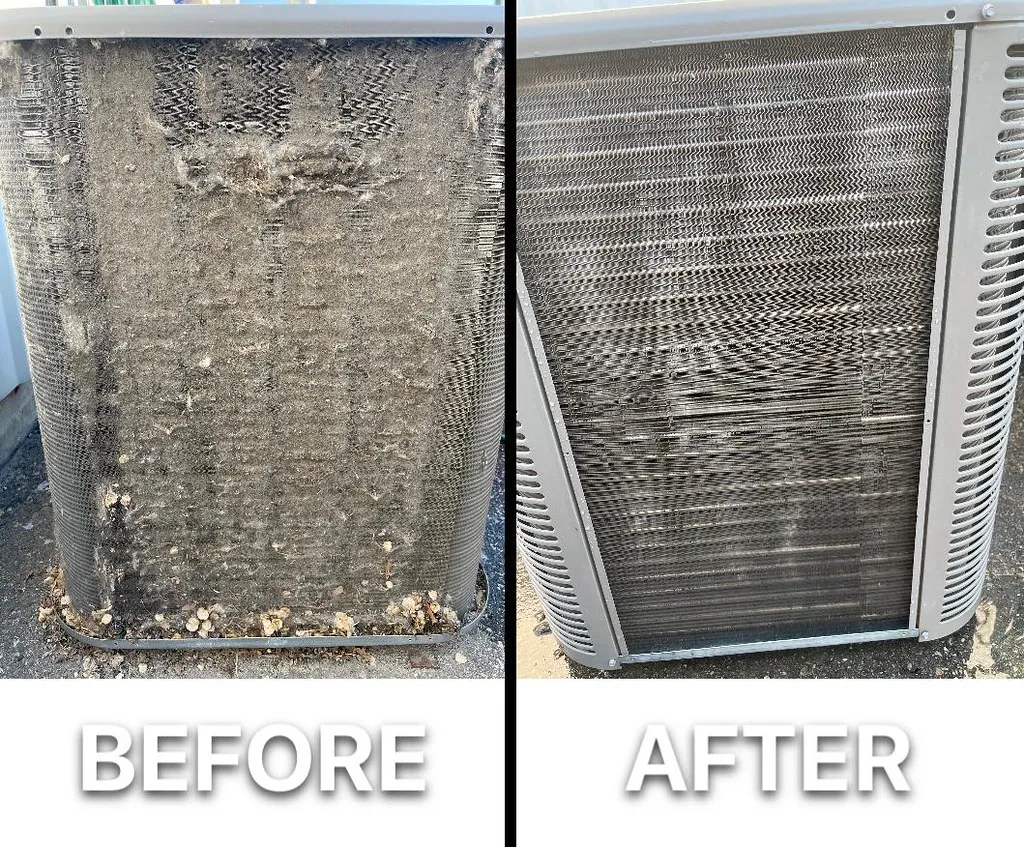
Photo: Vernon Air Conditioning / Flickr — CC BY 4.0 ( source )
How old is my AC unit?
The data plate is on the outdoor condenser The outdoor unit that releases heat pulled from inside your home. Full definition , usually a metal sticker on the side of the cabinet. You want two things from it.
- Manufacture date, if printed directly. Some manufacturers print it plainly and you are done.
- Serial number, if not. Most manufacturers encode the year, and often the week, in a format specific to that brand.
- Model number, which usually encodes the size. Look for a two-digit group like 24, 30, 36, 42, 48, or 60, and divide by 12 for tons. A 48 is a 4-ton system.
- Refrigerant type: R-22, R-410A, or R-454B. This matters enormously and is covered below.
Any technician can date a system in thirty seconds during a routine visit. If you are on New Braunfels Utilities, the $80 AC checkup rebate makes a spring tune-up close to free, which is the cheapest way to get a professional read on both the age and the remaining life. The repair cost guide compares that rebate with the alternatives.
Which New Braunfels homes are running out of time?
Roughly one home in five is at or past the clock already. Census data shows 10,071 New Braunfels homes, 22.6% of the city, were built from 2000 to 2009, and original equipment in that cohort reaches the DOE's 18-year expectation between 2018 and 2027. Another 13,863 homes built in the 2010s enter the same window starting in 2028. U.S. Census Bureau, ACS 2024 5-year estimates, table B25034
New Braunfels has one of the newest housing stocks in the United States, and that is the single most important fact about air conditioning here. New Braunfels city figures, retrieved 2026-08-04.
| Built | New Braunfels | Share | United States |
|---|---|---|---|
| 2020 or later | 4,047 | 9.1% | 2.0% |
| 2010 to 2019 | 13,863 | 31.1% | 9.4% |
| 2000 to 2009 | 10,071 | 22.6% | 13.6% |
| 1990 to 1999 | 3,783 | 8.5% | 12.4% |
| 1980 to 1989 | 3,926 | 8.8% | 12.9% |
| 1970 to 1979 | 3,723 | 8.4% | 14.2% |
| Before 1970 | 5,104 | 11.5% | 35.5% |
| Total | 44,517 | 143.8m |
Against 25.1% nationally. So when a national article opens with advice for owners of forty-year-old houses, it is talking to roughly one New Braunfels homeowner in nine.
Now cross it with the 18-year number
Take the DOE’s 18 years and apply it to original equipment, era by era. This is arithmetic, not modeling, and it produces a replacement calendar for the whole city.
| If your home was built | Original system reaches 18 years | Where you stand in 2026 | Homes |
|---|---|---|---|
| 2000 to 2009 | 2018 to 2027 | At or past expectation. Either already replaced once, or overdue | 10,071 |
| 2010 to 2019 | 2028 to 2037 | 7 to 16 years old. Approaching, not there | 13,863 |
| 2020 or later | 2038 onward | Young. Different problems entirely, sizing above all | 4,047 |
| 1990 to 1999 | 2008 to 2017 | On its second system, itself now 9 to 18 years old | 3,783 |
| Before 1990 | Long past | Third system or later. Age tells you nothing, condition does | 9,588 |
Not a sales pitch, a demographic fact about a city that built 24,000 homes in twenty years. If your house went up in the 2000s boom and nobody has replaced the system, you are not unlucky. You are on schedule.
The 1990s cohort is the one people get wrong
A 1996 house is thirty years old, so owners assume the system is thirty years old and either panic or write it off. It almost never is. Original equipment in that cohort died somewhere around 2008 to 2017, which means the system in the yard is a replacement that is itself now nine to eighteen years old and quietly approaching its own expectation. The house age is a red herring. Find the actual install date.
And the newest homes have the opposite problem
If your house was built after 2015 and the system is already struggling, age is not the explanation. Sizing usually is. A professional who runs heat-load calculations for HVAC contractors, describing this market in public forum discussion:
When you replace your AC or build a house, your contractor should always run a heat load to properly size your unit. Unfortunately this does not happen that often. A bad contractor will look at the size of your existing unit and just replace it with the same size. If the unit was never sized properly then that improper size gets handed down from unit to unit.
That mechanism matters more here than almost anywhere, because an oversized system in a humid climate short-cycles: it hits the thermostat setting fast, shuts off before it has pulled meaningful moisture out of the air, and starts again a few minutes later. The house feels cool and clammy, and the compressor racks up start cycles, which is the wear that actually kills compressors. Oversizing is a lifespan problem disguised as a comfort problem.
There is also a design ceiling worth knowing: homes here are engineered to an outdoor design condition of roughly 94 to 99 degrees, per the same forum’s local HVAC professionals, so above that a correctly sized system straining to hold setpoint is at the edge of its specification, not broken. One former field technician pushed back that this argument sometimes excuses an undersized install. Sizing is covered properly in the system size guide.
Can I still get R-410A for my system?
Yes. Servicing an existing R-410A system stays legal indefinitely, and as of July 2026 the EPA even removed the deadline that briefly limited installing remaining pre-2025 R-410A equipment. But production is phasing down to 15% of baseline by 2036, so the refrigerant gets scarcer and pricier across most of the service life left in this city's systems. U.S. EPA, HFC phasedown under the AIM Act
A system’s mechanical life and its economic life are not the same thing, and for anyone buying or keeping a system now, the refrigerant The refrigerant in most pre-2025 systems. Manufacturing of new R-410A systems was banned in 2025, so parts will get scarcer. Full definition timeline is the one that bites first.
| Refrigerant | Status | If your system uses it |
|---|---|---|
| R-22 | Production and import ended 2020 | Any significant repair is a replacement conversation. Reclaimed supply only, priced accordingly |
| R-410A | New residential systems no longer manufactured. Production phasing down to 15% of baseline by 2036 | Legal to service indefinitely, but the refrigerant gets scarcer and dearer through the phasedown |
| R-454B | The current replacement | What a new system will use |
A system installed in 2015 has eight years left on the DOE expectation, every one of them on the steep part of the R-410A decline. It may not fail before it becomes uneconomic to keep topped up, and that is the question people forget to ask.
One thing changed in July 2026, and most articles have not caught up
Signs a New Braunfels system is near the end
Weigh these as evidence, not as a checklist that adds up to a verdict. Each item tells you something different.
- A refrigerant leak on an R-410A system. The strongest single signal. Refrigerant is not consumed; if it is low, it left, and it will leave again. See the arithmetic in the repair cost guide.
- A compressor or evaporator coil quote. Both are four-figure repairs, and both usually mean the rest of the system is the same age. Read the compressor guide first.
- Two or more service calls in one cooling season. Not a rule, a pattern. Components of the same vintage tend to fail in sequence.
- Rising bills with no change in habits. Efficiency degrades gradually and is easy to miss because it happens over years.
- Running continuously without holding setpoint below the mid-90s outside. Ambiguous: could be age, could be sizing, could be duct leakage. Worth a diagnosis rather than an assumption.
- Age past 18 with none of the above. Genuinely fine to keep running. Plan, do not panic.
Should I replace my AC before it fails?
Locally there is a real financial case for it. CPS Energy, the largest electric utility in Comal County, pays $115 to $310 per cooling ton for early replacement against $90 to $275 for replace-on-burnout, so a planned swap earns a larger rebate than a desperate one. It also buys you three calm quotes in January instead of one in August. CPS Energy HVAC rebate specifications
On a 4-ton system at the middle SEER2 tier, early replacement earns roughly $700 against $600 for replace-on-burnout. That is on top of losing the ability to gather three quotes calmly in a mild month instead of one desperate quote in an August heat wave.
And check which utility you are actually on before assuming. Most local HVAC content assumes New Braunfels Utilities, but CPS Energy is the largest electric utility in Comal County at roughly 63,097 customers, ahead of NBU at roughly 47,854, per FindEnergy’s Comal County data. The two rebate programs are genuinely different: both pay toward replacement, but only CPS pays more for replacing early than after a failure, and only NBU pays for a standalone checkup.
| New Braunfels Utilities | CPS Energy | |
|---|---|---|
| AC checkup or tune-up | $80 | Not offered standalone |
| Smart thermostat | $85 | Varies by program |
| Programmable thermostat | $25 | — |
| System replacement | Up to $1,150 (high-efficiency systems) | $115–$310 per cooling ton, tiered by SEER2 |
| Pays more for replacing early than on burnout | No, flat cap | Yes ($90–$275 per ton on burnout) |
Sources: NBU rebates and CPS Energy HVAC rebate specifications, both re-verified 2026-08-25. CPS requires minimum 14.3 SEER2 and a Texas-licensed installer.
When a quote does arrive, the test is the 50% rule: if the repair exceeds half of what a new system costs, replace. At New Braunfels replacement averages, that threshold is roughly $2,500 – $4,000. Run your own numbers in the repair-or-replace calculator, see what the 18-year expectation does to repair pricing in the repair cost guide, and when the answer is replace, start with the replacement cost guide.